
Dust And Light
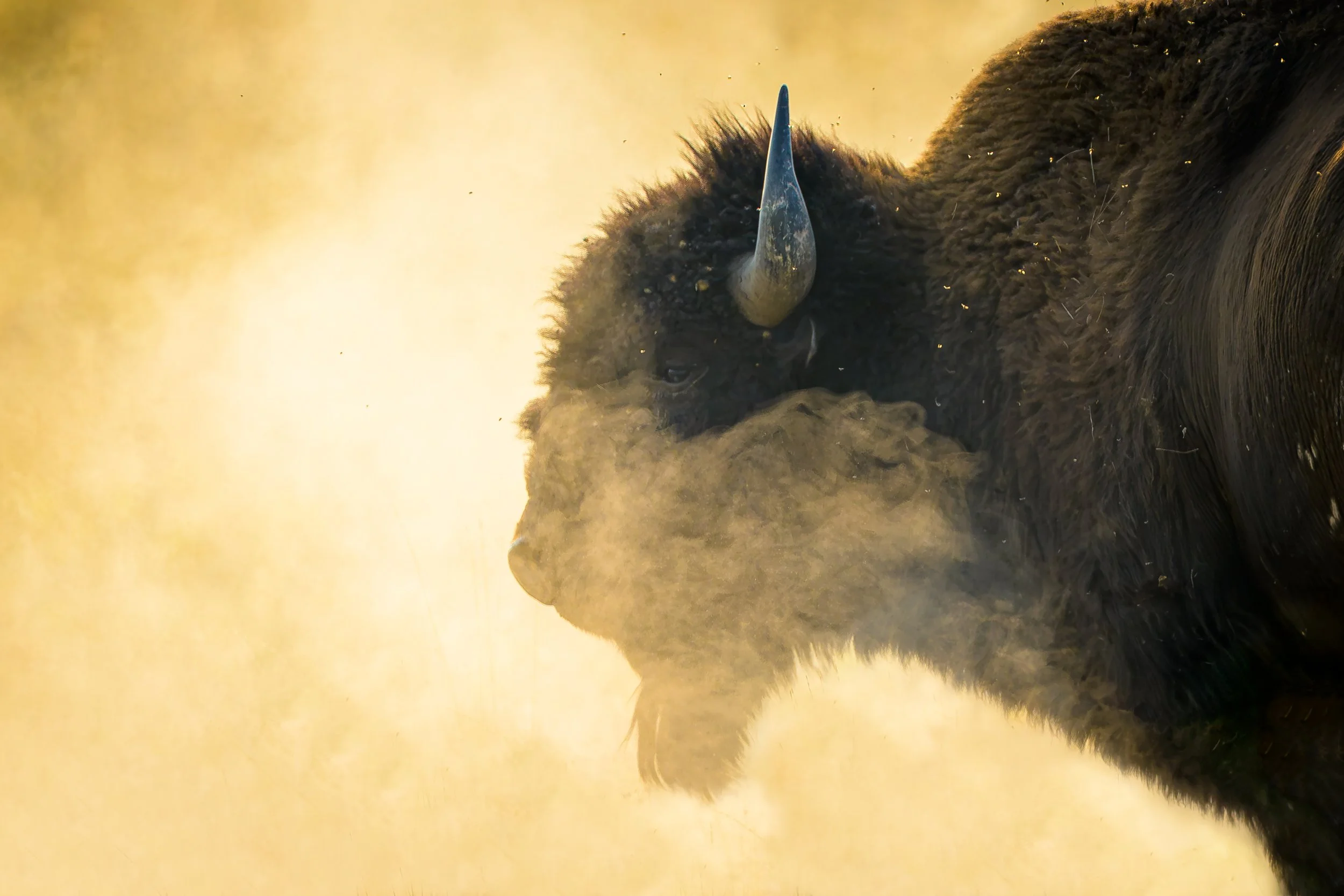
Back in the day, wildlife photographers used to talk in dry terms about finding the “plus value.” That is to say, the detail in the situation or the scene that could elevate the photograph that’s not the animal itself. Me, I like to call it capturing the essence of the situation. When photographing the bison rut, dust kicked up by these great beasts and suspended in the air is an ever present thing. By looking past the fights and displays of dominance, and focusing on finding ways to capture the magic of all that dust and its dance with light, we move beyond another photograph of a bison during the rut and instead find ourselves creating something entirely different, creative, and artistic.
Maybe it's all the dust. Or maybe it's how the quiet of the prairie suddenly transforms into something out of a horror movie. It’s probably adrenaline rush; suddenly finding yourself in the midst of it all, 2,500lb bulls bellowing and pawing the ground, swinging their heads, daring any would-be challenger to come any closer.
When the rut builds into this sort of testosterone fueled crescendo, I swear you can feel the electricity crackling through the air.
The good stuff is when you have multiple bulls, seemingly equally matched. Chances are, only one of those bulls will mate with the cows in the herd. That bull knows who he is. But the others are willing to risk everything to usurp his throne.
We call it a bellow. But it's more of a roar. Challenger after challenger. Then the dominant bull. Each bellow tells a story about size and dominance.
Testosterone begins to surge. The eyes become wild. The bellows and roars get louder.
A contender drops to the ground and wallows. Great plumes of dust rise into the air like so much smoke from a prairie fire. Then another. And another.
The dominant bull roars in contempt. He paws at the ground, sending waves of dust covered in his pheromones sailing on the wind. He drops to the ground and rolls.
And all of this before anyone locks horns.
If you've ever watched the elk rut with all the thrashing of antlers, tearing at the ground, and bugling; the bison rut is similar, but on steroids.
Posturing. Bellowing. The dust. Destroying anything and everything nearby that's not a cow. This is the theatre of the rut.
And that's important to understand when it comes to photographing the rut, of any species.
The performance is the point.
Yes, fights happen. Occasionally a challenger gets peeled open like a tin of beans by an old-fashioned can opener. Some of these bulls will die this fall and winter as a result of what transpires now. But the fact of the matter is this: none of these bulls want to fight. All they really want is to be seen as the strongest without paying the cost of proving it. It's why elk and moose grow massive antlers. It's why banging heads is so methodical and ritualized for bighorn sheep. It's why pronghorn engage in races to see who is the fastest. And it's why bison bellow, and wallow, kick up plumes of dust.
At the end of the day, they're just big peacocks strutting their stuff.
None of the females are judging a male's suitability based on his ability to kill or injure a challenger. Instead, think of the rush of a western grebe or the choreographed dances of a sharp-tailed grouse. For a male to compete, he must be in peak physical condition, having already won the genetic lottery, and commit everything of himself to the performance.
As a wildlife photographer, the performance is also the point.
For bison, it's the dust, the bellows, the bulls adorning themselves with sagebrush, the running through the open prairie, and the opportunity to photograph these animals at their absolute peak of physical condition.
More often than not, fights are all knees and elbows. Bison usually turn into two big brown lumps of fur with a bunch of dust. Occasionally, you find the separation you need to make magic happen. Occasionally a fight stumbles into a river. But usually it's just a chaotic mess.
So, when I'm photographing the rut, I focus my attention on the performance. I home in on the details, the behavior, the atmosphere of it all; the stuff you can't capture outside of this time of the year.
Over the years, I've come to think of this as capturing the essence of the subject and situation. Sometimes I show up with a list of adjectives or descriptive phrases in my head that I would use to describe the subject, the timing, the behavior I want, or the place. Sometimes I stumble upon it real time. But whatever that thing is, I throw all of my effort into finding ways to emphasize and capture that thing.
And for me, with the bison rut, the dust is everything.